
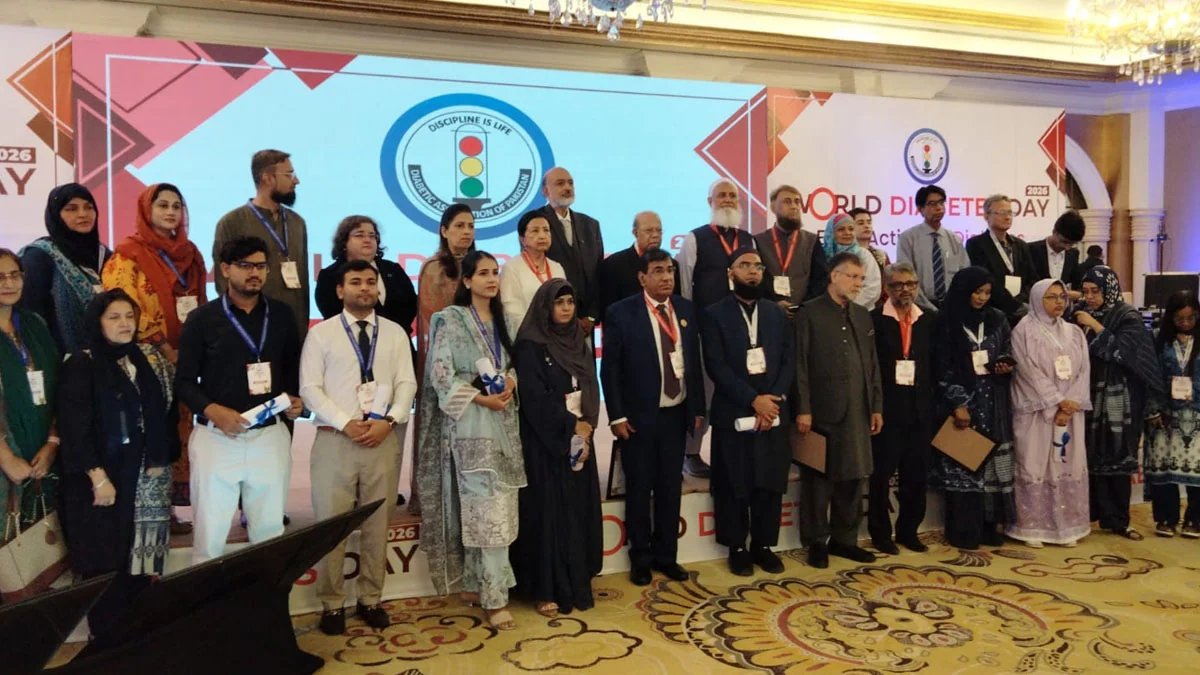
KARACHI: A one-day conference on the theme “Early Action on Diabetes” was organized at a local hotel on the occasion of World Diabetes Day under the auspices of the Diabetes Association of Pakistan (DAP), in which renowned diabetes experts and physicians from across the country and abroad participated.
Secretary General of the Diabetes Association of Pakistan, Professor Dr. Abdul Basit, said that for the first time in the country’s history, on the direction of the Prime Minister and in collaboration with the Ministry of Health, a formal national program has been prepared for the prevention and control of diabetes, which is being launched this month from the federal capital, Islamabad.
He said that the ‘Diabetes Prevention and Control Program’ will consist of a three to five-year phase, whose basic objective is to create public awareness across the country so that citizens can screen themselves through the ‘RAPID Score’, while in the next phase, medical facilities for diabetes prevention and treatment will also be established across Pakistan.
He thanked the Prime Minister, the Federal Minister for Health, and the Ministry of Health and said that with diabetes prevention and timely effort, it is possible to reverse (control) it, while details regarding the members of the committee formed for the launch of the program will come out in the next one to two weeks.
Professor Abdul Basit announced that after the successful experiment of diabetes awareness and screening through mosques in Bangladesh by renowned diabetes expert Professor A.K. Azad Khan, this model is now being introduced in 57 OIC member countries including Pakistan, which will begin in Pakistan in early 2027. He said that Professor A.K. Azad Khan and the Bangladesh Diabetic Association researched the concept that every human being is connected to his faith to some degree; therefore, in Bangladesh, initially, awareness was given to the Imams of 100 mosques and the women of their families, and through special sermons prepared with the approval of the Ministry of Religious Affairs, Al-Azhar University, and the Imam of Makkah, a one to two-minute awareness message was included every Friday, while screening of men was conducted outside mosques and screening of women in adjacent rooms.
According to research, a reduction of up to 42% was recorded in new cases of diabetes in those areas during one year, after which this campaign was expanded to about 300,000 mosques where this message is reaching 20 to 40 million people every Friday. Professor Abdul Basit said that the International Diabetes Federation (IDF) has also appreciated this model, and COMSTECH, a subsidiary body of the OIC, has appointed him as its representative and entrusted him with the responsibility of expanding this program in 57 Islamic countries.
He clarified that for this project in Pakistan, a grant application has been submitted to the Higher Education Commission (HEC), whose decision is expected in two to four months; however, even if the grant is not received, the project will be formally launched in early 2027 with personal resources.
Addressing and speaking at the scientific session, Vice President of the Diabetes Association of Pakistan, Professor Shabeen Naz Masood, warned that every third citizen in Pakistan is suffering from diabetes, and if blood sugar is not screened and controlled in time before or during pregnancy in women, this disease is transmitted to the mother and child as well as to future generations. She said that the basic steps for diabetes prevention (Primordial Prevention) should not begin after a heart attack, kidney failure, or high blood pressure, but at the time when a woman intends to become a mother.
She said that diabetes during pregnancy shows no separate symptoms, therefore three-stage blood sugar screening is indispensable for pregnant women: the first test before conception or as soon as pregnancy is confirmed (booking) in the initial months, the second test at 22 to 24 weeks (fifth to sixth month), and due to the Pakistani and Asian population being high-risk, even if the first two tests are negative, a third test must be done at 34 to 36 weeks (eighth to ninth month). She warned that what the public ignores by merely considering it “baby diabetes”, if not treated in time, such women become victims of permanent Type 2 diabetes within three to four years.
Vice President (Academics) of the Diabetes Association of Pakistan, Professor M. Zaman Sheikh, said that Pakistan has become the diabetes capital of the world with a 33% prevalence rate, while diabetes is a “Silent Killer” which does not cause apparent discomfort for the first eight to ten years, and even when the sugar level reaches 300, the patient remains careless.
Expressing concern over changing lifestyles and mental stress, he revealed that one burger contains at least 500 calories, while one cold drink contains as much sugar as six cups of tea, which directly causes obesity, cholesterol, blood pressure, and diabetes. He emphasized that patients should make exercise and weight training a routine from the first day of diagnosis along with medicines.
Vice President of the International Diabetes Federation (IDF), Irum Ghafoor, said that modern technology “Continuous Glucose Monitoring” (CGM) is extremely useful in effectively controlling diabetes and preventing people with pre-diabetes from becoming permanent patients, while the impression that CGM devices are only within the reach of the rich is wrong.
She said that this device, which shows blood sugar readings every three to five minutes without pricking a needle, is helpful for both the patient and the physician in making correct decisions, and in Pakistan, very low-cost CGM devices are available in the range of Rs. 8,000 and Rs. 17,000 to 18,000 up to Rs. 150,000 and Rs. 200,000, with the use of which people with overweight and family history can keep themselves safe from permanent diabetes.
Other renowned medical experts and teachers from across the country also participated in the inaugural, concluding, and various scientific sessions of the conference, including Professor Noor Jehan Samad, Professor Ashar Fawad, Professor Yaqoob Ahmedani, Professor Iqbal Afridi, Professor Ahmed Bilal, Professor Nusrat Shah, Professor Dr. Shabnam Shamim Asim, Professor Sonia Naqvi, Professor Romina Iqbal, Professor Karim Qamaruddin, Professor Seema N. Mumtaz, Professor Muhammad Adnan Kanpurwala, Professor Zeeshan Ahmed Junejo, Professor Khair-un-Nisa Nizam, Dr. Riasat Ali Khan, Dr. Asma Khan, Dr. Fareeduddin, Dr. Asma Ahmed, Dr. Farah Naz Farooq, Dr. Zakir Alvi, Dr. Nadeem Naeem, Dr. Ali Asghar, Dr. Saima Zubair, Dr. Shaheen Zafar, Dr. Faiza Rauf, Dr. Samira Jabeen, Dr. Shabnam Naveed, Dr. Aqiba Sarfraz, Dr. Sanobar Jamal, Dr. Ayesha Sheikh, Dr. Qamar Masood, Dr. Syed Adeel Zafar, Dr. Khalid Abdul Basit, and Dr. Shehla Naseem.