
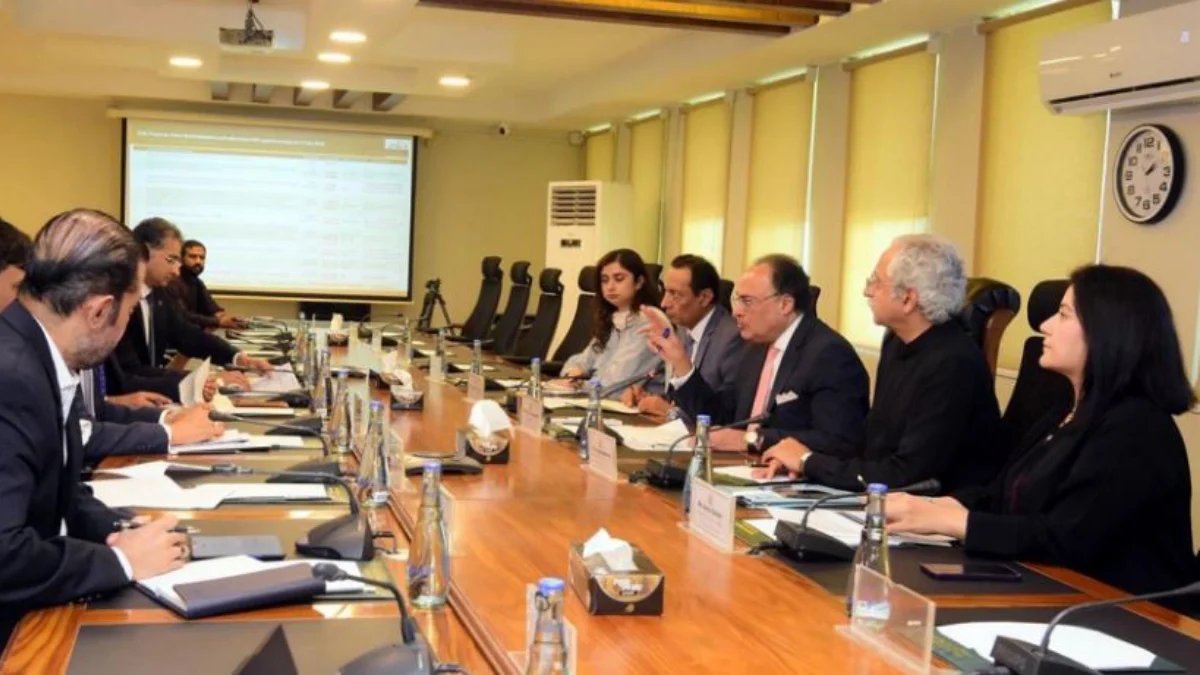
Federal Minister for Finance and Revenue, Senator Muhammad Aurangzeb, chaired the fortnightly meeting of the Access to Finance Steering Committee to review progress on initiatives to expand affordable and inclusive finance across housing, agriculture, SMEs, exports, information technology, renewable energy, and other priority sectors.
The committee noted significant progress across select Access to Finance initiatives since the close of FY26, alongside important legal, regulatory and institutional reforms strengthening the overall financing ecosystem.
The finance minister said the objective is to channel greater financial-sector capacity towards productive investment, enterprise creation, home ownership, agricultural productivity and exports, translating macroeconomic stability into stronger, private sector-led and inclusive growth.
The committee noted that total housing finance increased from around Rs.294 billion at the end of June to Rs.307 billion by mid-August.
Progress under the Wazir-e-Azam Apna Ghar Program – Ghar Ho To Apna accelerated significantly.
Since June, applications increased 52 percent to nearly 139,000, approvals rose 84 percent to over 46,000, approved financing nearly doubled from Rs144 billion to Rs279 billion, while loans disbursed increased 59 percent to over 7,600, amounting to more than Rs38 billion.
This momentum is being supported by a strengthened legal and regulatory framework to further propel mortgage-based lending. Reform initiatives include the State Bank of Pakistan’s revised Prudential Regulations for Housing Finance, including a 90:10 loan-to-value ratio, 65 percent debt-burden ratio, informal-income assessment models, simplified property valuation and documentation, digital processes and longer financing tenors.
The committee particularly highlighted the passage of the Financial Institutions (Recovery of Finances) (Amendment) Act, 2026 (FIRA) as a major structural reform strengthening the legal framework for recovery and enforcement of mortgage-based lending.
A stronger and more predictable recovery framework is expected to improve lender confidence, support greater availability of housing finance and help deepen Pakistan’s mortgage market.
The committee noted that as financing constraints are progressively addressed and demand for housing finance increases, the housing and construction industry must also step up on the supply side by bringing forward more quality and affordable housing units to meet growing demand.
This can create a broader multiplier across construction, cement and building materials, allied industries, SMEs, employment and overall economic activity.
Agriculture borrowers increased from around 3.26 million at end-June to 3.37 million by mid-August, adding approximately 115,000 borrowers, while agriculture financing remained around Rs1.26 trillion.
Under Zarkhez-e – Asaan Zarai Qarza, more than 58,000 farmers have registered. The scheme is designed to provide uncollateralised financing to smallholder farmers, including tenant farmers, primarily for agricultural inputs. Since June, bank approvals increased around 12 percent to nearly 16,700, approved financing limits reached over Rs7.2 billion, while loans disbursed increased around 13 percent to nearly 5,000.
The Committee stressed faster conversion of applications and approvals into financing to support agricultural productivity, rural incomes and financial inclusion.
On SMEs, formal financing stood at around Rs1.05 trillion, covering approximately 330,000 businesses.
The committee reviewed the ongoing credit-scoring pilot across 13 banks, aimed at improving credit assessment through proxy and alternative methods to assess cash flows and widening access beyond traditional collateral-based lending.
The medium-term ambition is to expand both agriculture and SME financing to Rs1.5 trillion by June 2027 and Rs2 trillion by June 2028, alongside substantial growth in their respective borrower bases.
The committee placed particular emphasis on connecting Access to Finance with the Government’s export-led growth agenda, reviewing enhanced financing and refinancing support for exporters and SMEs, including access to working capital and long-term investment finance.
It also welcomed the Performance Based Rebate on Incremental Exports (PRIE), effective July 1, 2026, under which exporters achieving growth of up to 10 percent are eligible for a 1 percent rebate on incremental exports, while growth above 10 percent attracts a 2 percent rebate. Particular emphasis is being placed on enabling export-oriented SMEs to access financing through banks under facilities administered by the Export-Import Bank of Pakistan (EXIM Bank).
The Finance Minister emphasized that SME finance, export refinancing, long-term investment finance and performance-based incentives must work together to enable businesses to invest, increase productive capacity, improve competitiveness and generate additional exports and foreign-exchange earnings.
Progress was also reviewed under the Pakistan Accelerated Vehicle Electrification (PAVE) Programme. By mid-August, more than 83,000 applications had been received, around 15,800 approved and nearly 4,000 loans disbursed. Since June, approvals increased by around 24 percent, disbursements by 34 percent, while electric vehicles delivered more than tripled from 471 to over 1,500.
The committee also reviewed the Prime Minister’s online digital housing portal and emphasized stronger integration among relevant institutions to simplify access to financing.
The Finance Minister emphasized that Access to Finance should increasingly operate as an integrated economic-enablement framework — combining legal and regulatory reforms, digitalisation, better credit assessment, targeted financing, risk-sharing, refinancing and performance-based incentives.
He directed regular bank-wise weekly and month-on-month monitoring of financing, borrower growth, approvals and disbursements, with implementation bottlenecks brought before the Steering Committee with clear recommendations for timely resolution.
He also called for wider public awareness through frequent communication so that farmers, SMEs, exporters, prospective homeowners and entrepreneurs are fully aware of available financing opportunities.
This, he noted, would also help generate greater momentum in private-sector credit offtake and encourage innovative financing solutions.
Concluding the meeting, Senator Muhammad Aurangzeb said access to finance is ultimately about expanding access to economic opportunity.
The Government’s objective is to enable households and businesses to own homes, expand farms and enterprises, invest in productive capacity, increase production and compete in international markets.
He stressed that the expanding Access to Finance ecosystem should translate into greater investment, stronger construction and agricultural activity, more competitive SMEs, higher exports, employment generation and sustainable, inclusive economic growth, and called for continued coordination among the Finance Division, State Bank of Pakistan, Securities and Exchange Commission of Pakistan, Pakistan Banks’ Association, relevant ministries, financial institutions and other stakeholders to accelerate delivery.