

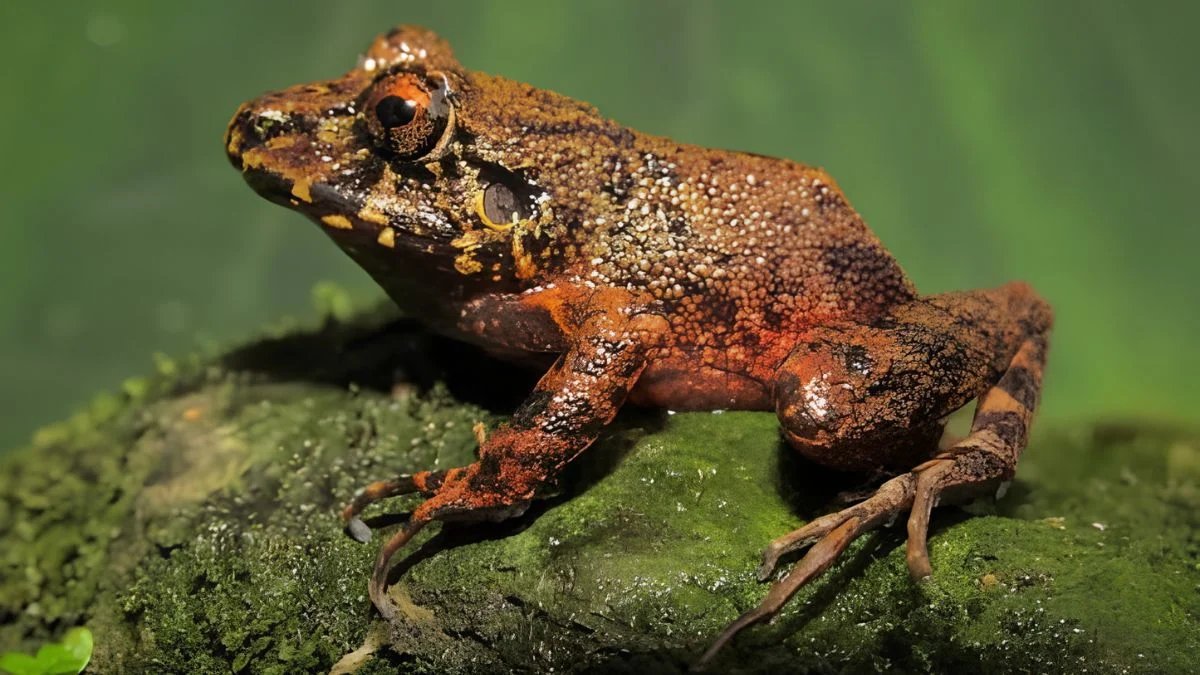
A team of biologists and taxonomists worldwide has officially identified and described a new frog species that remained unnoticed by science for over a century. This species was overlooked for nearly a hundred years, misclassified, and hidden in museum collections and in its natural habitat.
Old records mistakenly grouped the frog with more common local species. Researchers discovered it after using advanced genetic testing and closely re-examining museum specimens collected many years ago.
The Milpe Robber Frog (Cutín de Milpe) is active at night. Males usually call from leaves on shrubs and bromeliads a few meters above the ground. Their calls are loud and stand out, sounding like a “click.”
Male and female frogs look quite different. Females have bright colors around their groin and thighs, with orange or light blue shades mixed with black spots. Males usually have more even coloring.
This frog lives in the forests of Ecuador’s Chocó region and southern Colombia, an area known for its rich biodiversity and conservation importance.
Later field trips showed that populations of this elusive frog have survived in their natural habitats, going completely unnoticed by today’s herpetologists.
Environmental conservationists say this discovery shows major gaps in our knowledge of global biodiversity. It proves that even well-studied areas can hide unknown species.
Taxonomists stress that correctly identifying hidden species is an important first step for conservation. This is especially true as habitat loss and climate change put fragile ecosystems worldwide at risk.
The official description of the new species was published in ZooKeys, an international journal that covers biodiversity and taxonomy.