
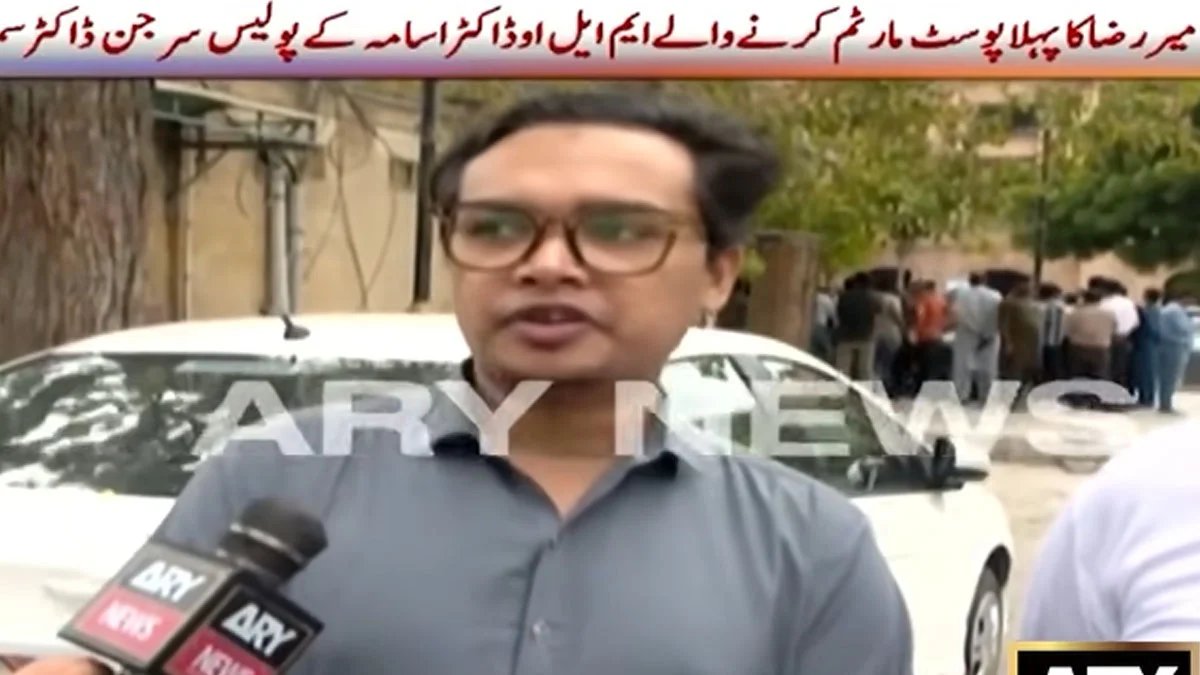
KARACHI: Medico-legal doctor Osama Sheikh was summoned again by the investigation committee probing the Mir Raza case following revelations made in his interview with ARY News.
According to sources, the investigation committee summoned Dr Osama today and questioned him about his statement aired on the media.
The committee asked Dr Osama about the matter after his interview with ARY News and questioned him regarding the revelations made during the interview, sources said.
Dr Osama recorded a video and written statement before the investigation committee, with the statement lasting around one hour, according to sources.
He also presented various evidence and other material along with his statement, sources said.
During his statement, Dr Osama said that Dr Samia, Jibran Nasir and he were present when the final report was being prepared.
Dr Osama’s latest statement has been attached to his earlier statement recorded under Section 161, sources said.
The investigation committee, headed by DIG Amir Farooqui, will submit Dr Osama’s statement to the judicial commission, according to sources.
Earlier, Medico-Legal Officer (MLO) Dr Osama Sheikh, levelled serious allegations against Karachi Police Surgeon Dr Summaiya Syed, who conducted the second autopsy in the case.
In early August, Dr Summaiya pointed out discrepancies between the first medico-legal report prepared by Dr Osama and the available photographs. Following this, Ali’s body was exhumed at the request of his family and a second post-mortem examination was conducted.
Dr Summaiya told the judicial commission on Monday that she had faced “threats” after raising questions over the findings of the first post-mortem conducted in the murder case of young businessman Mir Raza Ali.
Speaking to ARY News on Tuesday, Dr Osama alleged that Dr Summaiya was trying to implicate him in the case.
“I swear that Dr Summaiya trapped me,” he alleged, adding that she had told him, “If I have trapped you, I will also save you.”
Dr Osama said he wanted to discuss the facts of the case before the commission but felt that the proceedings had shifted away from the central issues.
“I conducted Mir Raza’s first post-mortem. I am the primary evidence,” he said.
He said the facts should be brought before the court, expressing hope that the judge would give him an opportunity to present his position at the next hearing.
Responding to questions about discrepancies between his findings and the second post-mortem, Dr Osama said the issue was not necessarily about whether something was right or wrong, as certain details could sometimes be missed during an examination.
“No person is perfect. That does not mean things have gone wrong,” he said.
Dr Osama also discussed his experience in examining firearm injuries, saying that he had examined cases involving the same weapon being fired from different distances made different sizes of wounds.
He maintained that the size of an entry wound does not necessarily have to be smaller or larger depending on the location where a bullet strikes.
“I will try to prove the things I have written in my report,” he said, adding that a review of his timeline of events could clarify several aspects of the case.
Dr Osama further said he had arrived prepared to submit an apology but, unfortunately, did not get the opportunity to do so. He added that he had not been prepared during the previous hearing but had come fully prepared this time.