
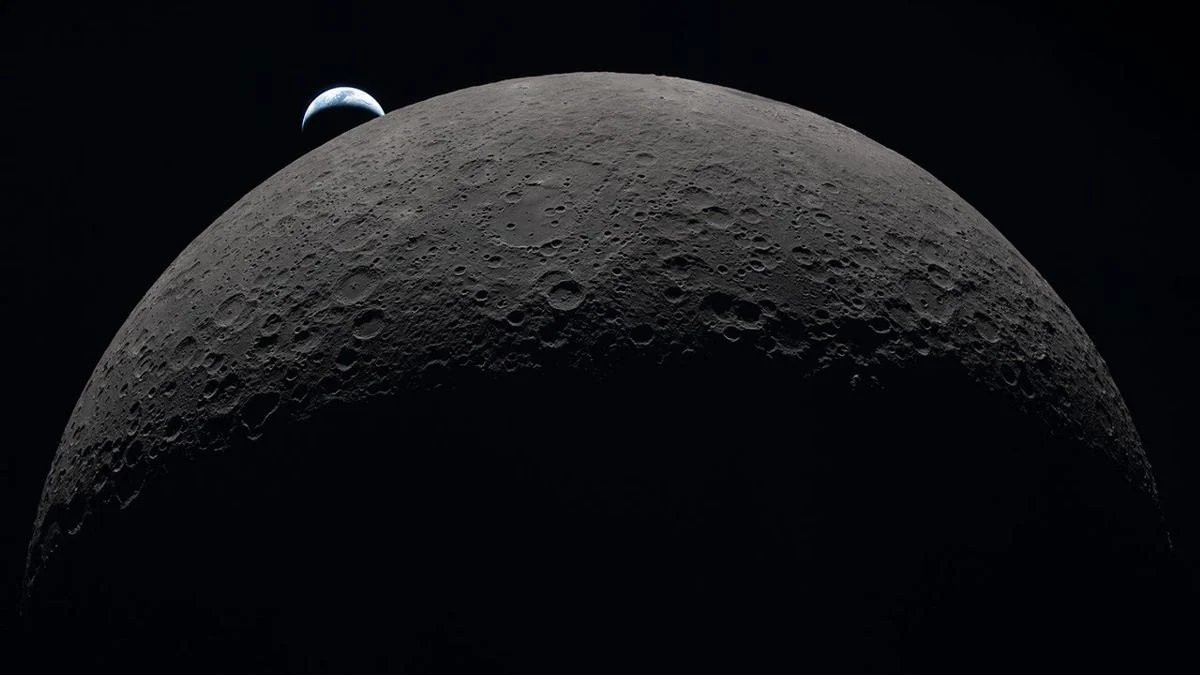
Water is essential for sustaining life. As countries compete to establish a lasting human presence on the moon, having enough water is a major challenge.
Elon Musk has imagined building permanent human settlements on the moon and Mars. Growing plants on the moon is important for long-term lunar bases because they provide food, oxygen, medicine, water purification, and waste recycling.
However, water behaves very differently on the moon compared to Earth, according to a new research study.
Research by John Z. Kiss, Karl H. Hasenstein, and Christopher P. McKay shows that surface tension is much more important in the moon’s lower gravity, which is only one-sixth of Earth’s. This makes water flow less freely than it does on Earth.
“The surface tension is more of a factor in how water flows. In essence, it doesn’t flow as freely in lunar gravity because of the surface tension,” said Kiss, who is Florida Tech’s provost and senior vice president for academic affairs.
“If you’re going to water plants on the moon, you might have to design the whole system a little bit differently than you would on Earth.”
The researchers also ran a simulated flight experiment during a Blue Origin New Shepard flight in February 2025. They used about two minutes of simulated lunar gravity, created by spinning, to see how pure water, a salt solution, and a 30% glycerol solution behaved in containers.
In the experiment, water did not move well because lunar soil is made of fine dust and rock fragments that do not absorb water easily. With limited water flow, this makes irrigation difficult, reduces oxygen, and can harm plant growth.
Of the solutions tested, the glycerol solution flowed better. This suggests that certain additives might help water soak into lunar soil more effectively in the future.
The custom hardware, which included cameras and accelerometers, worked well. The researchers plan to build on this for longer studies and future experiments on the actual lunar surface.