

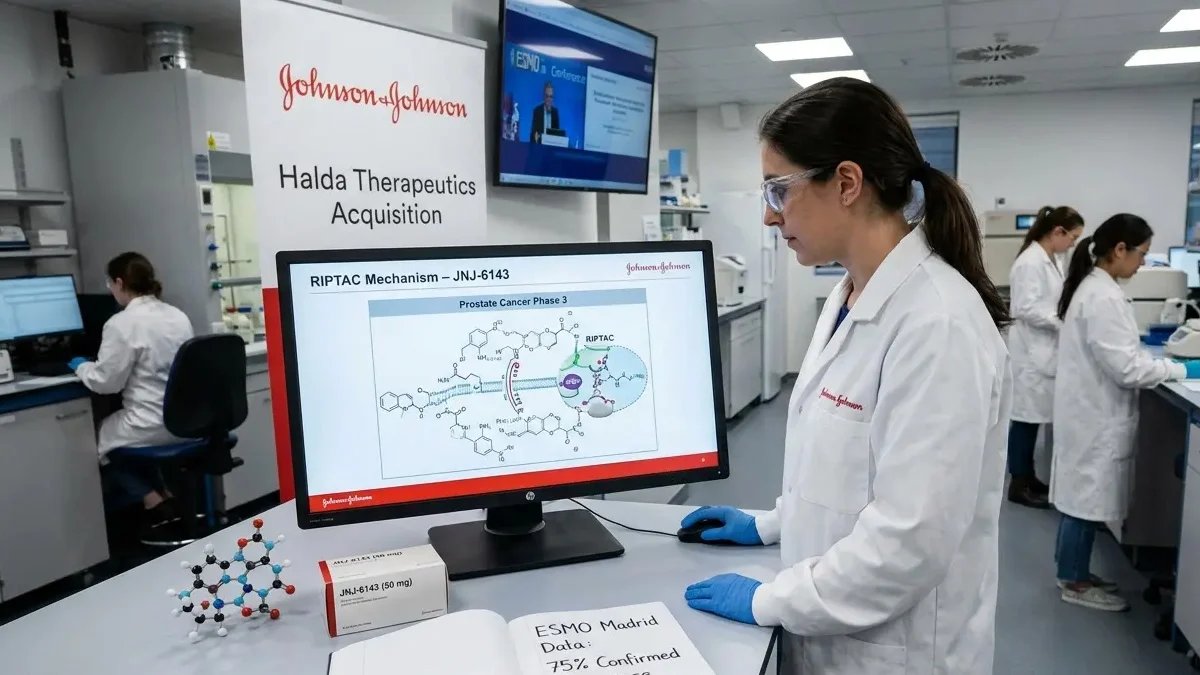
Johnson & Johnson on Saturday said its experimental once-daily oral prostate cancer drug caused tumors to disappear or shrink in an early-stage trial.
J&J had gained access to the drug through its $3.05 billion deal to buy Halda Therapeutics last year.
Johnson & Johnson is testing its experimental drug JNJ-6143 in patients with advanced prostate cancer who have received multiple prior treatments.
The therapy takes a novel approach by selectively killing cancer cells by interfering with a protein they need to survive.
The early trial data is strong. Among 31 evaluable patients receiving the 50-milligram dose, 77% saw their PSA levels — a key blood marker used to monitor prostate cancer — fall by at least 50%. In 48% of patients, PSA levels dropped by at least 90%. Among patients whose tumors could be measured through imaging, 75% had a confirmed complete or partial response.
Analysts are optimistic about its potential. “JNJ-6143 could be a game changer for the treatment of prostate cancer and for JNJ’s oncology franchise prospects,” said Leerink Partners analyst David Risinger. A Johnson & Johnson spokesperson added, “It adds a new mechanism of action to J&J’s prostate cancer portfolio.”
The drug was generally well-tolerated. Common side effects were nausea and elevated cholesterol and triglyceride levels. Only one patient discontinued treatment due to adverse effects.
The data were presented at the European Society for Medical Oncology Congress.
About JNJ-6143
JNJ-6143 is an investigational, once-daily molecule that uses the novel RIPTAC platform. Its targeted dual-protein lock brings together BRD4, an essential protein for cell survival, and the tumor-selective protein, androgen receptor (AR), which is highly expressed in prostate cancer cells, and is designed to disrupt cancer cell function and trigger cancer cell death.