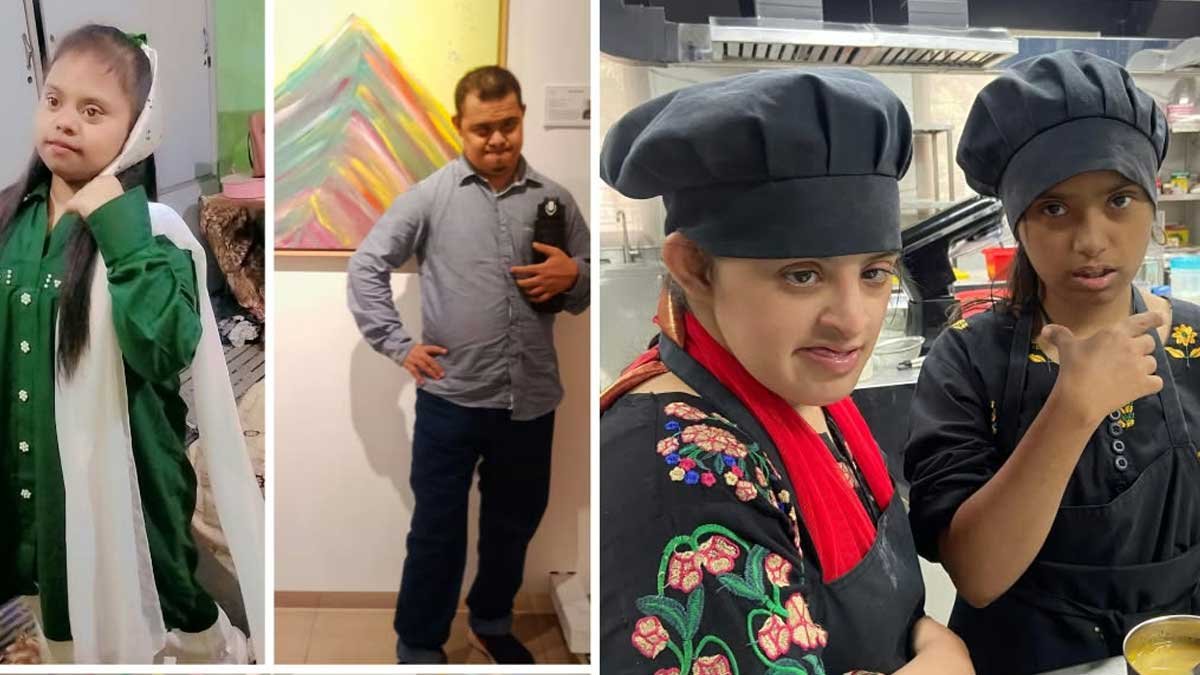
Two weeks ago, I interviewed the MS of one of the biggest public hospitals in Karachi. As we were in the elevator — by “we” I mean my daughter BB Marium and I — a young doctor whispered, loud enough for everyone to hear, “She is Down Syndrome. She is Down Syndrome,” repeating it twice to make sure everyone knew.
I turned and said, “What do you mean? Should I say you are a human being, so that everyone can know?”
One can be surprised how a doctor could be so desensitized as to embarrass a parent in public. But this is normal for every parent who has a child with visible features of being special, like Down Syndrome. The word people normally use is “abnormal,” to be precise.
A parent of such a child gets used to these words, these stares, as if they are aliens. To the ironic attitude of people pulling their children away from ours, as if our child is mentally ill or a dangerous species. And irony is that other normal children either bully them or make fun of them. As Gandhi put it, “The measure of a society is how it treats its most vulnerable.”
No matter how much we have emotionally, personally, and financially invested in their education, upbringing, and discipline, so that they look decently dressed, confident, well-behaved, and calm — for them, they are still “abnormal.”
This is the quiet cost of a desensitized society. It begins with misinformation in healthcare. It continues on the street. And it leaves families fighting alone for access to schools, therapy, and basic inclusion. When we stop seeing the person, we also stop seeing the need for inclusion in schools, clinics, and workplaces.
“The Wound Is Where The Light Enters”
— Rumi
I spent the last two weeks meeting parents of children with Down Syndrome. I wanted to understand one thing: what does life with dignity look like when society has stopped seeing you?
Saba Kamran, mother of Hassan, recalled the day Hassan was diagnosed.
“I was emotionally shattered,” she said. “The physician told me, ‘People will suggest therapy, but you don’t need to. They are slow in physical development and they will never grow mentally.’”
She followed that advice.
“I regret those four years,” Saba said. “There was no awareness. No examples to follow. Parents hide children like Hassan to save themselves from embarrassment. So you think you are alone.”
“You Are Not Greater Than The Creator”
Naseem Mohammad Saleem stitches clothes at home for a livelihood. She is the mother of Fatima Gul, 18, who sat quietly, well-dressed and calm.
For a long time after her birth, Naseem didn’t even know her child had Down Syndrome. “When I found out, a doctor told me not to invest in her. He said children like this don’t live long.”
Naseem’s reply was simple. “You are not greater than the Creator. I will do whatever is in my capacity.”
Her goal is to see Fatima grow into an independent, self-reliant young woman.
But outside her home, the struggle continues.
“People stare,” she said. “They ask, ‘Yeh malang hai na?’ No matter how much we work on discipline and education, for many people she is still just ‘abnormal.’”
“Every Step A Celebration; Every Gaze A Theft”
I heard the same pattern again and again — in clinics, markets, at family events. Stares. Whispers. Embarrassing queries.
Ifrah, sister of Imran, said: “Imran was born right after me. He is the second child.
It was traumatic for my parents to accept a male child with Down Syndrome. But after the shock came the realization. They did everything to educate him and help him excel in learning skills.
Despite all of this, wherever we take him — parks, weddings, malls, events — people stare at him. Those stares and gazes make Imran conscious and afraid.
He loses all the confidence that we have spent so many years building in him.”
Sanober Rehmatullah, mother of Riffah, who graduated in screen printing, said her daughter has a skill, a qualification, a talent.
And still, people fail to see her strength. For them, she is just “darvesh” and “malang.”
Pointing to society’s failure, parents reflected:
“For us, each tiny step is a celebration and a milestone. But society’s non-acceptance of our children has taken away the joy of their present achievements. It has made us only worry about their future.”
Ifrah added, “This attitude has made us forget the most important part — that today is about enjoying each day of their growth.”
“From Fear To Faith: Let Them Be Empowered”
“It is not our abilities that show what we truly are, it is our choices” — J.K. Rowling
Ms. Samana Batool, associated with the welfare and counselling program for Down Syndrome, understands the deprivation and pain of parents who come for counselling.
“It shows the huge gap that the media and other stakeholders have left in creating awareness in society,” she said. “We encourage parents to celebrate their everyday progress and trust their abilities.”
“At our organizational level, we are doing our level best to address Down Syndrome from an early age, especially for education. But the need is much higher, and resources are limited.”
Her mission for every DS parent and family: “Let them be empowered. Make them confident. And learn from them. The change will definitely follow.”
Another special educationist, Ms Sidra Sajid, with a post-graduation in Psychology, said the biggest challenge is parents who come with fear about the future.
“Some parents are not even ready to accept that this is a genetic issue, where there is a difference in chromosome 21. Down Syndrome is a genetic condition that affects physical features and developmental milestones. Most of them look alike, that is why some people also call them ‘mongol.’”
“Some parents even go to the extent of considering it a result of black magic, or believe that a taweez would get rid of it.”
But she also sees change.
“People are no longer neglecting such children. Parents are now bringing them for all types of therapies and education.
The parent has to accept their children and trust them. It’s not necessary that if a child is not good at computers, he can perhaps do very well in painting or weaving. You just need to trust their capabilities.”
“13 Competencies and 7 Deficiencies; Potential Infinite”
Speaking to Mr. Farman Ali Tanwari, Regional Director, Department of Empowerment of Persons with Disabilities, DEPD Sindh, he said the Sindh government is fully geared to make society more inclusive through NGO partners like KDSP, KAVTC, MALC and others.
“Chief Minister Syed Murad Ali Shah and Secretary Taha Farooqui are exploring different ways to bring neurodivergent and borderline children into the mainstream education system. For this purpose, an MoU has been signed with Aga Khan University Institute for Educational Development to train teachers,” he said.
DEPD Sindh is running 67 institutes across Sindh, and is working to establish more.
He shared: “Previously there was 1 child with Down Syndrome in 2100 children. Today it is 1 in 700. There is no conclusive proof of such a rise. But the urgency to cater to these children is rising.”
Negating the idea that society has no empathy, he said: “I have seen a rise in the number of parents bringing their children to our educational and vocational centers.”
“Every individual has 13 in-built competencies and 7 in-built deficiencies. In Down Syndrome, it is deficiency plus. But with physical, occupational, behavioral, and speech therapy, they can become productive and useful citizens.”
“Sindh is the first province to implement the CRPD – Convention on the Rights of Persons with Disabilities of the UN in full spirit. The purpose is to protect the rights and dignity of persons with disabilities, and ensure equality and inclusion.”
“Chale Chalo, Manzil Abhi Nahi Aayi”
“Hope is the thing with feathers that perches in the soul” — Emily Dickinson
In a session titled ‘Chale Chalo ke Manzil Abhi Nahi Aayi’ of parents of differently-abled children, a father, Saeed Anjum, who did a post-graduation in Special Education after having a neurodivergent child, said:
“The journey is long, but even a constant drop of water can crack a stone.”
He shared, “I have created a special room for my child, Fahd Anjum, where I exhibit all his handmade things. Whoever comes to visit us is surprised to know that his differently-abled child can do what even a ‘normal’ child cannot. Only our children can be agents of change. They will serve as role models. No one else can do this job for us,” he said with commitment.
Another father added firmly: “There was a time, 4 decades ago, when girls were not allowed to attend school or go for higher education. But today you see girls on every front. There will be a time when society will accept our children too. The more we expose them in malls, parks, and events instead of being embarrassed about them, the better. We should present them as role models of good upbringing and education.”
While everyone was discussing the hurt and the fear for the future, I wondered: will it take another 4 decades for another Bibi Marium, Fatima Gul, Imran, Hassan, Hooria, Rifa, or Zikra to be accepted?
It is a long journey to cover and a battle to fight. But it is a fight worth winning.
As someone quoted Fehmida Riaz there:
Kuchh log tumhein samjhaayenge
Vo tum ko khauf dilaayenge
Jo hai vo bhi kho sakta hai
Is raah mein rahzan hain itne
Kuchh aur yahaan ho sakta hai
Kuchh aur to aksar hota hai
Par tum jis lamhe mein zinda ho
Ye lamha tum se zinda hai
Ye vaqt nahin phir aaayega
Tum apni karni kar guzro
Jo hoga dekha jaayega!
The writer is a senior journalist and columnist covering crime, law, social issues, governance, energy, health, literature, and women and children’s rights across Pakistan’s leading English media houses.