

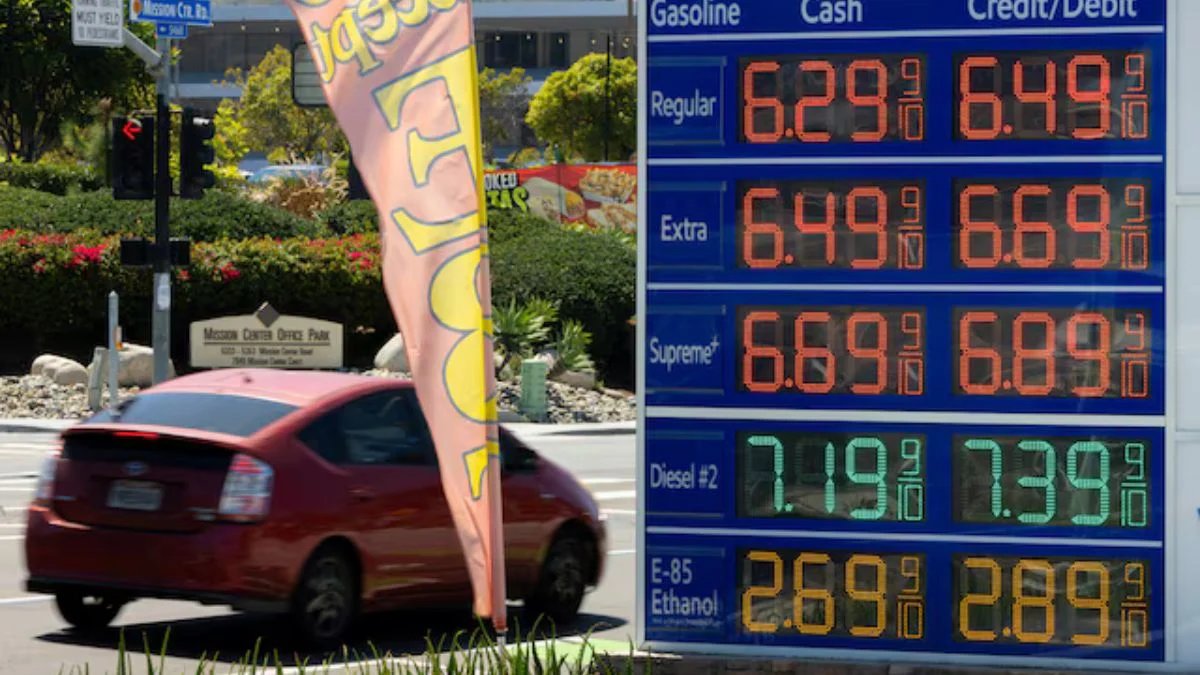
NEW YORK: With the war in the Middle East still raising energy costs, Americans face record-high gasoline prices for Labor Day weekend, just as political campaigns kick off for midterm Congressional elections.
The national average gasoline price will probably hit $4.03 on Labor Day, far surpassing the previous record of $3.83 per gallon set in 2012, said GasBuddy analyst Patrick De Haan.
“Gasoline, while not at all-time records, is at its highest level ever recorded this late in the calendar year, meaning Americans could for the first time ever see a national average price of gasoline above $4 per gallon on Labor Day,” De Haan wrote in a recent blog post.
The national average price of gasoline stood at around $4.13 per gallon on Thursday, up nearly a dollar from last year’s average, according to price-tracking service GasBuddy. Analysts say $4 per gallon is a pain point for many consumers.
Gasoline prices, among the most visible economic indicators for U.S. consumers, can quickly shape perceptions of the broader economy. With prices hovering above $4 a gallon for much of the year, the issue has become a persistent concern for President Donald Trump and his Republican Party.
Trump has pledged to lower energy costs. In recent weeks, he stepped up criticism of refiners and fuel retailers, accusing them of profiting from elevated pump prices. On August 14, Trump said Americans should be willing to pay a “tiny little bit more” for gasoline to ensure Iran could not obtain a nuclear weapon.
Labor Day is typically a final summer getaway for many Americans, with many people traveling by car or airplane.
Prices at the pump have climbed alongside crude oil prices, which this week jumped back over $90 a barrel after renewed military action between the U.S. and Iran revived concerns about disruptions to global crude supplies.
Prices of distillates, which include diesel and heating oil, also increased, driven in part by ongoing attacks on Russian refining facilities, which raised concerns about supply disruptions.
Retail fuel prices and crude oil typically move in the same direction because crude feedstock is the dominant cost for producing the fuel.
DRIVERS CUTTING BACK
“It’s completely out of control,” Randi O’Brien, 57, said while filling up her truck at a Phillips 66 near Evergreen, Colorado.
Colorado, along with Utah, Idaho, Montana, Wyoming, and North Dakota have recorded some of the steepest price gains since the war started. California, Hawaii and Washington currently have the nation’s highest average gasoline prices.
“I can only afford $15 worth of gas right now,” said O’Brien, who drives roughly 40 minutes round trip each day to work at Home Depot. She partially blames high prices on the rise in crude and fuel exports from the U.S. following the start of the Iran war, which prompted many countries to turn to America for fuel supplies.
Refined products exports are up more than 10% compared with last year, according to the U.S. Energy Information Administration.
“We have our own fuel here, yet we’re sending it elsewhere,” she said.
O’Brien’s struggles are being echoed by motorists across the U.S.
With the cost of even a routine grocery run climbing and household budgets already stretched, Houston resident Madison Moore, 28, said she was scaling back her Labor Day travel plans.
“It used to always be easy to pack up the car, go to Galveston out to the beach and have a cookout or something. People don’t want to move like that anymore though,” Moore said while filling up at a Shell gas station in Houston.
“You would think that our government can do a little bit more for their people when they actually need it.”
NO WIGGLE ROOM
Persistently high gasoline prices are primarily a supply story, said Kuan Dosmuratov, research analyst at consultancy Wood Mackenzie. Concerns about disruptions to energy shipments through the Strait of Hormuz have lifted both crude prices and refining margins, while attacks on Russian refineries have tightened fuel inventories across the board.
Currently, there are few operational and policy levers that can be pulled to boost fuel supplies. U.S. refinery utilization currently stands at 98%, the highest level since 2018. The government has already extended the Jones Act waiver, allowing easier fuel shipments between U.S. ports. Washington also ended summer-blend gasoline requirements early to try to cap prices.
U.S. gasoline inventories fell by 1.2 million barrels last week to 205.7 million barrels, the Energy Information Administration said on Wednesday. This compares with the five-year average for the month of August of 217.6 million barrels.
Prices for other refined products have risen sharply as well. U.S. diesel prices this week hit a new record while air travelers over the Labor Day holiday are expected to pay 20% more for tickets than a year earlier, according to AAA.
“The public doesn’t obsess with diesel but I see a better than even chance that retail numbers will surpass the all-time record of about $5.82 per gallon from June 2022,” Tom Kloza, chief energy adviser at Gulf Oil, said. “It presents a worrisome future.”