

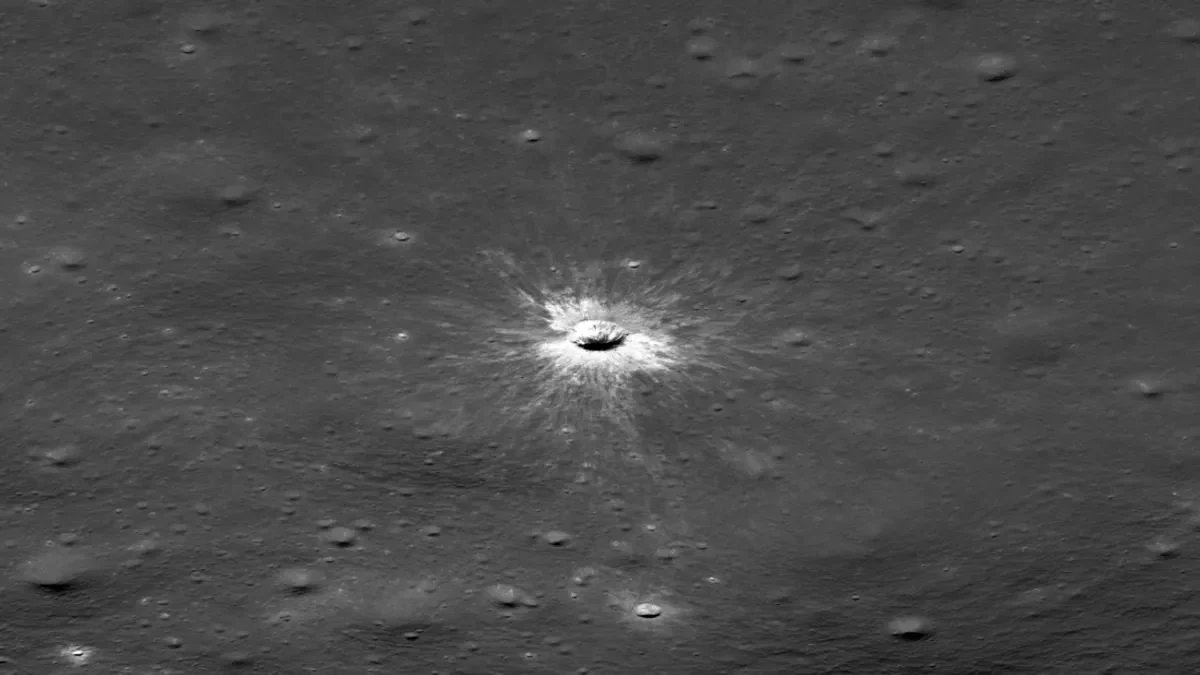
NASA’s Lunar Reconnaissance Orbiter (LRO) has found the largest new impact crater on the Moon in its 17 years of mapping. This discovery gives scientists new information about how space collisions change the Moon’s surface.
Scientists named the crater McGetchin after lunar geologist Tom McGetchin. It is about 222 meters (728 feet) wide and 43 meters (141 feet) deep.
The crater sits on the Moon’s eastern edge and is large enough to fit Rome’s Colosseum inside. Scientists think it formed between April 11 and May 22, 2024, when an asteroid or comet about the size of a three- to six-story building hit the Moon at very high speed.
According to models based on the Neukum crater production function, craters this big form on the Moon only once every 132 years. Before this, the largest new crater the LRO found was only 70 meters wide.
Robert Wagner, an image-processing expert at Intuitive Machines, first spotted the crater by noticing its large blast area in images from the Lunar Reconnaissance Orbiter Camera (LROC).
The impact threw up lunar soil and created bright rays that stretched for kilometers around the crater. Wagner said this was the most noticeable debris pattern the orbiter has ever recorded.
Thermal measurements showed something unexpected. With the LRO’s thermal radiometer, scientists found a huge “cold spot” about 6.4 kilometers (4 miles) wide around the crater.
During the Moon’s two-week-long night, temperatures in this area drop 16 degrees Fahrenheit lower than nearby ground. Researchers say the shockwave made the surface soil less dense, so it cannot hold onto heat from the lunar day as well.
These findings are important for future crewed missions to the Moon. Loose, low-density soil could be dangerous for rovers and building foundations, showing that the lunar environment can be risky for long-term projects.