
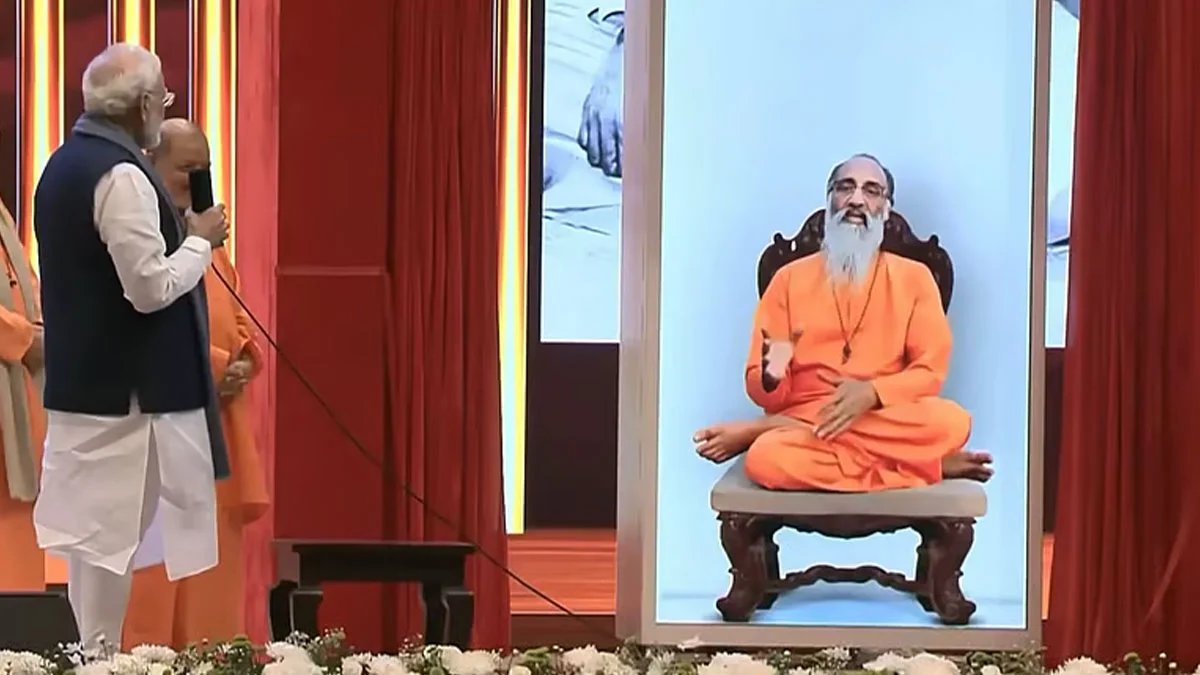
Indian Prime Minister Narendra Modi’s recent appearance with a holographic avatar of the late spiritual master Swami Chinmayananda, created with the help of artificial intelligence, has sparked a whirlwind debate on online platforms.
During a programme at the Chinmaya Amrit Mahotsav Global Summit at Bharat Mandapam, New Delhi, Prime Minister Modi interacted face-to-face with an artificial intelligence bot with a hologram using state-of-the-art voice and image replication technology.
The lifelike avatar of the late Chinmayananda, who died in 1993, is believed to have engaged in a real-time interaction with Mr. Modi by mimicking his famous voice and mannerisms to reminisce about the last time they met in Vadodara 35 years ago.
Though the members of the organizations and the gathering witnessed the homage to the technology in real, multiple videos uploaded to the social media also went viral online with the netizens having mixed reactions over the technology worldwide.
Some netizens appreciated the innovative use of artificial intelligence with culture, citing the project as a creative way of paying homage to prominent spiritual leaders and preserve history.
During the occasion, Prime Minister Modi expressed his nostalgia, mentioning that “I felt as though I went 33 years back in the time” after talking to the hologram.
On the other hand, a vociferous section of social media users opposed the app, with one posting having come on the back of online servers into a storm by drawing sweeping references to technological revolutions in other countries, and questioning the direction of society when using advanced AI to create appearances of holy men.
Many were appalled at the use of leading edge AI to make virtual godmen instead of industry or scientific breakthroughs.
As the digital debate continues, such an unlikely incident raises some broader questions about the complicated and swiftly changing ways in which emerging technologies are impacting collective grievances, commemorative, and recalibrating historical moments and breaking new ground in present-day India.
Consequently, even as the demonstration showcased unprecedented advancements in speech synthesis and holographic projection, it also catalyzed a wider discussion on what it means to incorporate deep tech in the spheres of culture, spirituality, and governance.